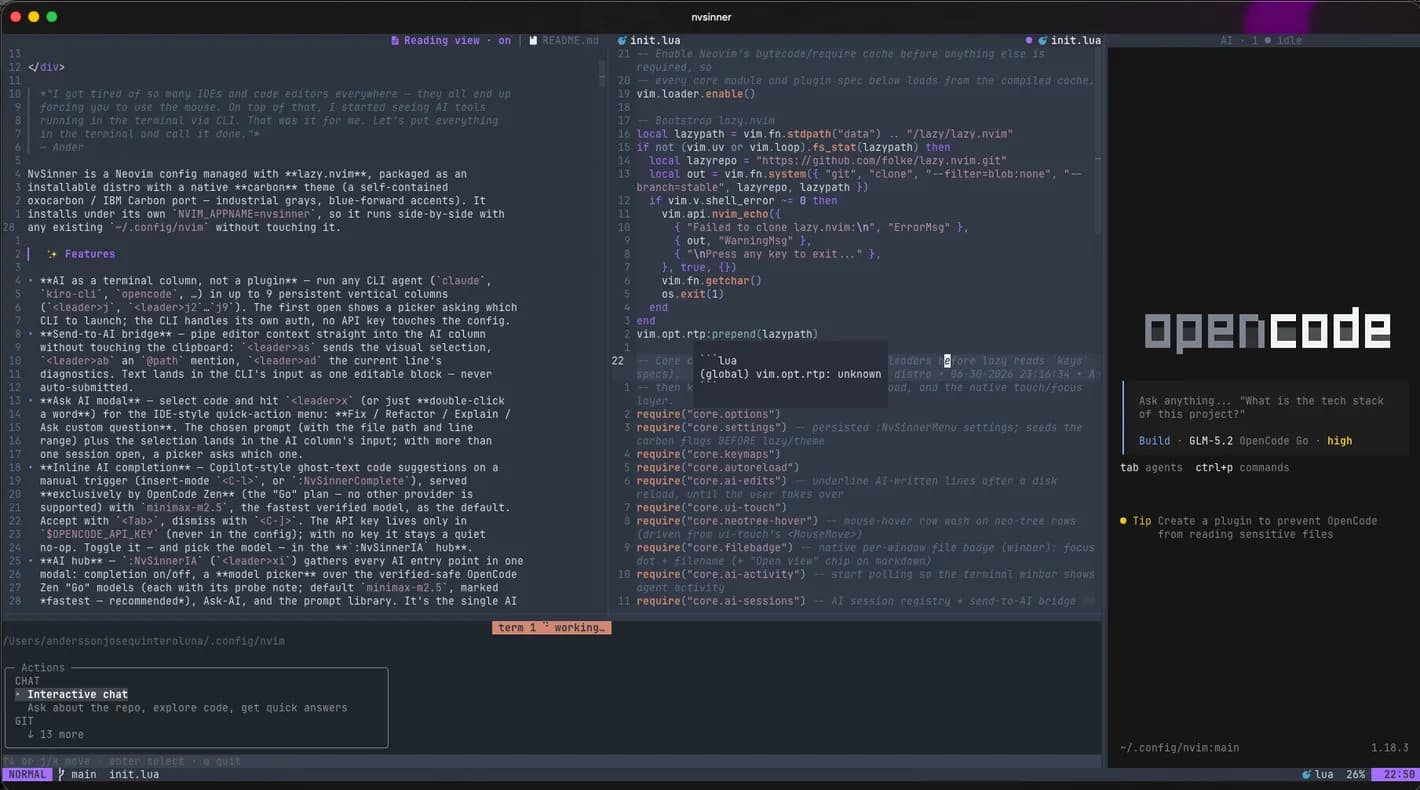
NvSinner
NvSinner was born from a simple frustration: every IDE and code editor kept forcing my hands onto the mouse, while the AI tooling I actually enjoyed was moving into the terminal as CLI agents, and every AI editor kept putting a chat panel where my code should be. So I put everything in the terminal.
NvSinner is my open-source Neovim distribution, which I created and maintain since 2026. It is managed with lazy.nvim and packaged with a one-line installer, and it turns Neovim into a Cursor-like AI IDE with no in-editor AI plugin at all. It installs under its own NVIM_APPNAME, so it runs side-by-side with any existing Neovim setup without touching it.
The core idea is AI as a terminal column, not a plugin: any CLI agent (Claude Code, opencode, or just a plain shell) runs in up to nine persistent vertical columns, each carrying a live activity bar that shows whether its agent is thinking or idle. The CLI handles its own authentication, so no API key ever touches the config, and anything the editor sends to an agent lands in its input unsubmitted, for you to read before pressing Enter. When an agent edits a file on disk, the open buffer reloads automatically and a toast names exactly what changed, turning the editor into a cockpit for supervising agents rather than a text box. A JSON-backed prompt library, a Mason-style settings modal, and a self-discovering command palette round out the workflow, all fully keyboard-driven.
Under the hood it is an exercise in native-first engineering, in Lua: the activity spinner, disk auto-reload, settings persistence, health checks, and updater are zero-dependency core modules rather than plugins. It ships its own self-contained carbon colorscheme, an oxocarbon / IBM Carbon port, with dark and light variants, transparency, and per-role accent slots, all configurable live from the settings modal. Everything is lazy-loaded (headless cold start sits around 40 ms), plugin versions are pinned to a committed lockfile, and a Plenary test suite covers the core behavior.
It is MIT licensed and maintained in the open on GitHub; the command palette in the gallery reads v1.1.0. The reasoning behind the terminal column, and how to try a distro without touching your own config, are written up as notes on this site.