Mastro Signals
Mastro Signals is a personal SaaS project from 2025 that connects TradingView PineScript indicators with an Express backend to deliver automated alerts by email. The problem it addresses is readability: a raw indicator alert says that a condition fired, and the goal was an alert a non-technical trader could actually act on.
It is my own project, built end to end as a Full-Stack Developer: the indicator side in PineScript, the Express backend that receives the alerts, the AI layer and the email delivery.
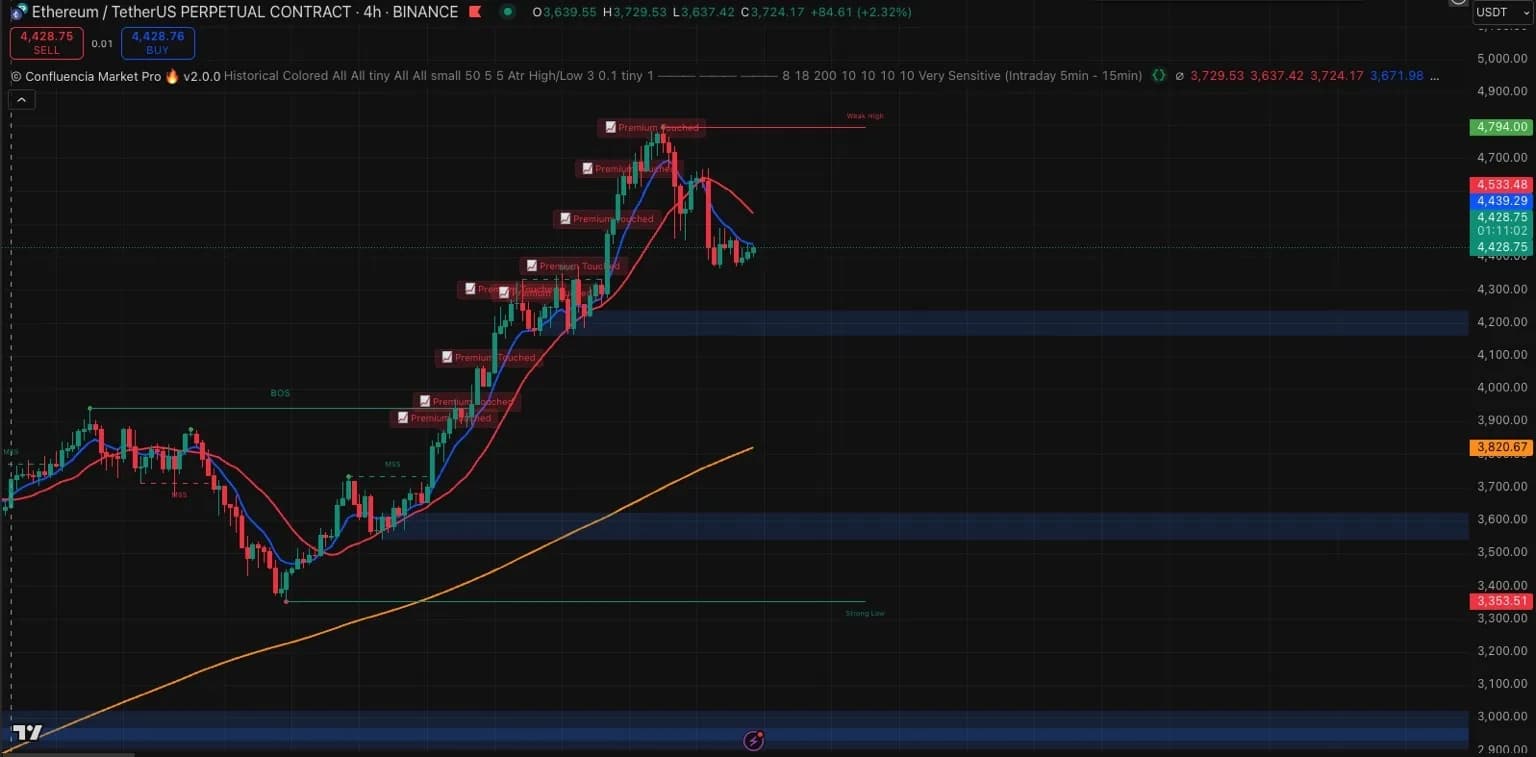
The pipeline starts on the chart. The indicator (Confluencia Market Pro in the screenshots) marks market structure, premium zones and three moving averages, an EMA 8, an SMA 18 and an SMA 200, and a TradingView alert on one of its conditions, such as a triple moving-average cross, fires a webhook. Its message is a JSON payload carrying the symbol, interval, timestamp, price, volume, the three averages and the recipient's email and token. The Express backend takes that payload, asks OpenAI GPT-4 for a natural-language summary of the trade, and Nodemailer sends the result.
The email reads like an analyst's note: the recommended next action, a suggested entry, leverage, take-profit and stop-loss levels, a short explanation of why, a read on liquidity and relevant news, and a closing reminder that it is an AI suggestion based on technical data, not financial advice. Integrating an AI layer into a real-time signal pipeline required careful performance tuning: I designed prompt strategies and caching mechanisms that kept API costs low while still delivering coherent, high-quality summaries on every alert.
The stack is deliberately small: PineScript on TradingView, Express.js, OpenAI GPT-4 and Nodemailer. The goal was to prove that an AI-augmented product could be both polished and economically viable without excessive API spend, and the service is live.